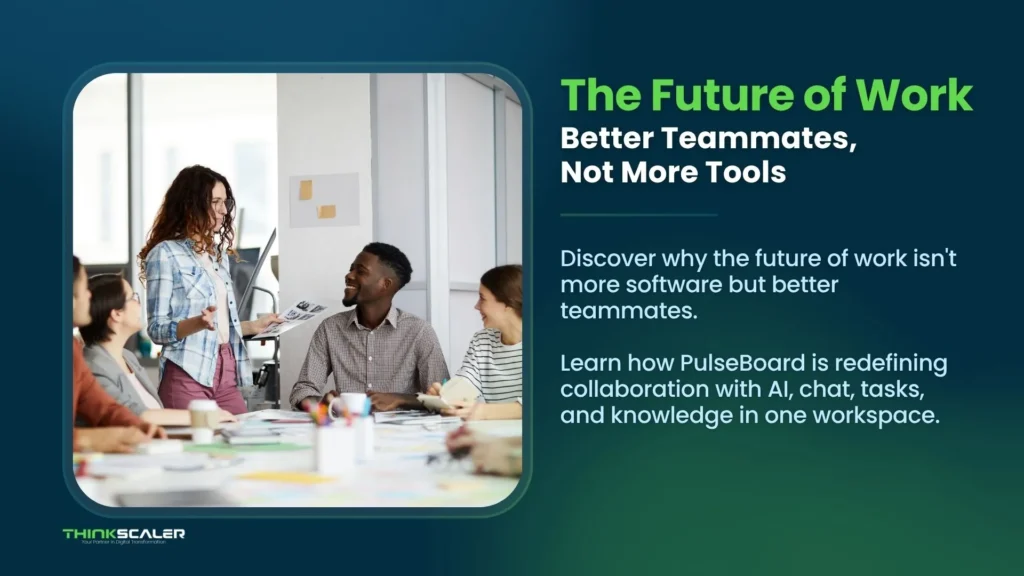
Over the past decade, businesses have invested heavily in workplace software. Teams now rely on dedicated applications for messaging, project management, documentation, meetings, approvals, file sharing, and knowledge management.
Every platform entered the market with a common promise: to make work easier, faster, and more efficient.
Yet, despite having access to more technology than ever before, many organizations are facing an unexpected challenge. Employees often spend significant time navigating between tools, searching for information, tracking conversations, and trying to reconstruct the context behind decisions. Instead of simplifying work, the modern software ecosystem has introduced new layers of complexity.
The problem isn’t a lack of tools. It is the widening gap between how software expects people to work and how teams naturally collaborate.
The Hidden Cost of Fragmented Work
Real work rarely happens inside perfectly organized systems. It begins with conversations.
Someone asks a question in chat. An idea emerges during a meeting. A quick discussion turns into a task, which eventually becomes a project. As the project progresses, it generates knowledge, decisions, and insights that shape future work.
However, traditional workplace software treats these activities as separate experiences.
Conversations happen in messaging applications. Tasks are managed elsewhere. Documentation resides in a different platform. Files are stored in cloud drives, while meeting notes disappear into yet another system.
Weeks later, teams often find themselves asking the same questions repeatedly because the original context is difficult to locate. The information still exists, but the knowledge surrounding it has become fragmented.
For growing businesses, startups, agencies, and remote teams, this fragmentation comes with real consequences. Productivity decreases, decision-making slows down, employees spend more time searching than creating, and valuable organizational knowledge becomes trapped inside disconnected applications.
The challenge isn’t information overload—it’s context loss.
Why Conversations Remain the Center of Collaboration
Despite the availability of sophisticated workplace software, teams continue to rely heavily on messaging platforms for day-to-day collaboration.
The reason is simple: conversations feel natural.
People communicate ideas, solve problems, make decisions, and share knowledge through discussions. Collaboration is inherently conversational, which is why messaging applications remain central to how organizations operate.
The challenge arises when conversations evolve into actionable work.
A simple message saying, “Can you take care of this?” suddenly becomes a task. Multiple tasks transform into projects. Projects create documentation, processes, and institutional knowledge.
Unfortunately, most software solutions force teams to leave the conversation behind and manually move information into other systems.
Tasks belong in one application. Knowledge belongs in another. Reporting belongs somewhere else entirely.
But work doesn’t happen in isolated categories.
Work is fluid, interconnected, and constantly evolving.
The future of collaboration lies in preserving this continuity instead of breaking it apart.
AI Is Becoming a Teammate, Not Just a Tool
Much of today’s conversation around artificial intelligence focuses on automation.
AI can draft emails, summarize meetings, generate content, and assist with repetitive tasks. These capabilities undoubtedly improve efficiency, but they only scratch the surface of what’s possible.
The next evolution of AI will extend far beyond isolated requests. AI will become an active participant in how organizations operate.
Imagine assigning work to an AI assistant just as naturally as assigning work to a colleague. Imagine an intelligent system that remembers previous discussions, understands project history, recognizes organizational priorities, and proactively surfaces information when it is needed.
Instead of waiting for prompts, AI could follow up on pending tasks, help onboard new employees, summarize project progress, and maintain alignment across teams.
This vision represents a significant shift.
The future of AI isn’t another chatbot sitting inside a sidebar.
It’s a teammate that understands context, contributes meaningfully, and evolves alongside the people it supports.
Simplicity Will Define the Next Generation of Software
As workplace applications have become increasingly feature-rich, they have also become increasingly complicated.
Large enterprises often have administrators, consultants, and dedicated implementation teams to manage complex systems. Smaller businesses and startups rarely have those resources.
They need tools that feel intuitive from day one. They need solutions that reduce friction instead of introducing more processes.
The most successful collaboration platforms of the coming decade will not necessarily be those with the most features. Instead, they will be the platforms that remove barriers between communication, execution, and knowledge sharing.
- Less searching.
- Less switching between applications.
- Less duplicate work.
- Less manual organization.
- More focus on outcomes.
- More clarity.
- More momentum.
Simplicity is no longer just a design principle – it is becoming a competitive advantage.
Building Toward a Better Way to Work
These observations inspired the development of PulseBoard.
PulseBoard is being designed for startups, growing businesses, agencies, and remote teams that want collaboration to feel effortless rather than overwhelming. At its core is a simple belief:
Work should happen where conversations happen.
Conversations should naturally evolve into tasks. Tasks should generate knowledge. Knowledge should improve future conversations. And AI should function as another teammate inside the workspace rather than another disconnected application.
Instead of forcing teams to manage multiple tools, PulseBoard aims to create a unified environment where communication, execution, knowledge management, and AI work together seamlessly.
We believe organizations don’t necessarily need more workplace software.
They need software that behaves more like a teammate.
Technology should help people stay aligned, preserve context, and move work forward – not create additional administrative overhead.
The future of work isn’t about adding more applications to an already crowded stack.
It’s about building better teammates.
And that’s the future we’re building toward with PulseBoard.
Frequently Asked Questions
PulseBoard is an AI-powered collaboration platform designed to bring conversations, tasks, knowledge, and teamwork into a single workspace.
PulseBoard is designed for startups, growing businesses, agencies, remote teams, and modern organizations looking for a simpler and more connected way to work.
Unlike conventional tools that separate chat, tasks, documentation, and knowledge management, PulseBoard keeps everything connected within a unified workspace.
Most work begins with conversations. PulseBoard is built around the principle that discussions naturally evolve into tasks, projects, and knowledge, preserving context throughout the process.
Yes. PulseBoard is being developed with AI-first capabilities to help teams stay aligned, automate repetitive work, surface relevant information, and improve productivity.
PulseBoard aims to reduce dependency on multiple disconnected applications by providing an integrated collaboration experience where teams can communicate and execute work seamlessly.
PulseBoard's AI is envisioned as an intelligent assistant that understands project context, remembers previous discussions, tracks progress, and helps teams stay organized.
Absolutely. PulseBoard is designed to support distributed and hybrid teams by enabling real-time collaboration, centralized knowledge sharing, and streamlined communication.
PulseBoard is currently under development, and early adopters can join the waitlist to receive product updates, previews, and early access opportunities.
You can sign up for the early access list to stay informed about development progress, feature releases, beta programs, and launch announcements.
Summary of this article:
Modern businesses are overwhelmed by disconnected workplace tools that create inefficiencies, context loss, and unnecessary complexity. This article explores why the future of collaboration is not about adopting more software but building better teammates. It introduces PulseBoard, an AI-first collaboration platform designed to unify conversations, tasks, knowledge, and intelligent assistance within a single workspace, enabling teams to work naturally, stay aligned, and focus on outcomes rather than managing applications.
About Thinkscaler Technologies:
NeoThink Scaler Technologies is a leading India-based ServiceNow consulting and delivery company, offering expert workflow modernization, implementation, and outsourced ServiceNow project execution for clients across India and worldwide. As a fast-growing and trusted organisation, we collaborate with global vendors to build and deliver high-quality ServiceNow solutions that drive efficiency, automation, and business transformation.
PulseBoard, AI collaboration platform, Future of work, AI workplace software, Team collaboration tools, Knowledge management platform, Chat based productivity software, AI powered teamwork, Collaboration platform for startups, Future of workplace collaboration, Modern workplace software, AI teammate platform, Remote team collaboration, Connected workspaces, Productivity software for businesses, Contextual AI assistants, Workplace automation platform, AI first collaboration tool, Unified team workspace, PulseBoard collaboration platform